

KNX – A Complete Guide to Intelligent Building Automation
Smart buildings are becoming the new standard. Homes, offices and commercial spaces are evolving into intelligent environments that improve comfort, efficiency and security. Among all automation technologies, KNX stands out as the most reliable, scalable and future‑proof solution.
This guide explains what KNX is, how it works and why it has become the global benchmark for professional building automation.
What Is KNX?
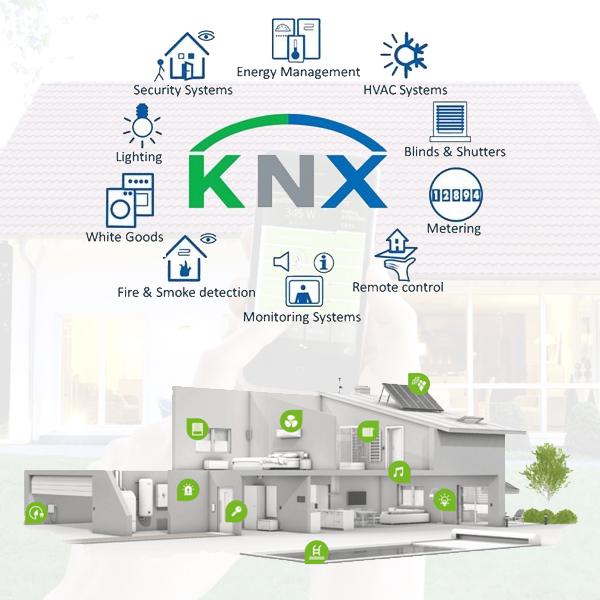
KNX is an open, international standard for building automation that enables seamless integration of lighting, shading, HVAC, security, energy management and multimedia systems. Supported by more than 500 manufacturers and thousands of certified products, KNX is one of the most versatile and future‑proof technologies available today.
A Decentralized Architecture for Maximum Reliability
Unlike consumer smart home systems that rely on a single central hub, KNX distributes intelligence across all devices. Each switch, sensor and actuator operates independently and communicates directly with other devices. This eliminates the risk of a single point of failure.
Example: If a KNX temperature sensor stops working, only that specific function is affected. Lighting, shading and heating continue to operate normally. In hub‑based systems, a gateway failure can disable the entire installation.
An Open Standard With Global Support
KNX is maintained by the international KNX Association and supported by over 500 manufacturers, more than 8,000 certified devices and a global network of trained professionals. This ensures long‑term availability, compatibility between brands and complete freedom of choice for designers, integrators and investors.
Security and Stability at a Professional Level
KNX operates independently of the cloud and does not require an internet connection to function. This ensures stable operation without external dependencies, no risk of losing control due to outages, full privacy and predictable performance. For enhanced protection, KNX Secure provides encrypted communication that meets the highest cybersecurity standards.
Remote Access and Visualization
Although KNX does not rely on the cloud, it fully supports remote access through secure gateways and visualization platforms. These systems allow users to monitor the building in real time, control lighting, HVAC and shading, manage energy consumption, receive alerts and create automation scenarios.
Centralized Management for Complex Buildings
KNX enables unified control of all building systems through a single interface. This is particularly valuable in commercial environments where lighting, HVAC, shading, access control and energy systems must work together seamlessly.
Energy Efficiency and Sustainability
KNX helps reduce energy consumption by optimizing heating and cooling, automating lighting based on occupancy and daylight, managing shading to reduce heat gain, integrating with photovoltaic systems and monitoring electrical loads. Many KNX‑equipped buildings achieve energy savings of 20–40%.
Key Functions of KNX
Lighting Control
Scenes, dimming, presence detection, daylight harvesting.
Shading Automation
Blinds, shutters, curtains, façade automation, weather‑based control.
HVAC Integration
Heating, cooling, ventilation, air‑quality monitoring, multi‑zone control.
Security & Monitoring
Motion sensors, leak detection, alarms, access control, presence simulation.
Energy Management
Load balancing, PV integration, smart metering, consumption analytics.
Multimedia & AV Control
Audio zones, video distribution, home cinema, integration with AV processors.
Garden & Irrigation Control
Irrigation scheduling, soil moisture sensors, outdoor lighting, pump control.
Access Control
Door stations, keypads, RFID, intercoms, integration with security systems.
Scenes & Automation Logic
Schedules, conditional logic, presence simulation, building‑wide automation.
Commercial Building Functions
Room booking, BMS integration, HVAC zoning, occupancy analytics, emergency lighting.
Conclusion
KNX is a global, secure and future‑proof standard for intelligent building automation. Its decentralized architecture, open ecosystem and professional‑grade reliability make it the ideal choice for both residential and commercial projects.